
Why Lingzhao Fang Chose Denmark (Again) to do His Groundbreaking Research
PORTRAIT: 38-year-old Tenure Track assistant professor Lingzhao Fang from Center for Quantitative Genetics and Genomics (QGG) is leading the extensive international FarmGTEx research consortium, and so far, he has published five articles in Nature Genetics. Earlier this year he received the prestigious Sapere Aude Grant from Independent Research Fund Denmark.

Lingzhao Fang is a well-known face at QGG. He came to Denmark in 2014 for a PhD position at QGG, which was then a center under Department for Molecular Biology and Genetics, located in Foulum close by Viborg.
His PhD thesis laid the very first sketches to the FarmGTEx project, an extensive project that so far has earned him five articles in Nature Genetics since 2022 and led to an extensive network – the FarmGTEx Consortium - with participants from over 100 universities around the world. More about that later.
During his PhD studies he met his wife in Foulum, where she was also doing her PhD thesis at QGG.
Of all places, you met her in Foulum?
‘- Yes, I met her in Foulum in the office, we were office buddies at QGG and both doing our PhD. And then we had our boy the same year I defended my PhD, so he is the same age as my PhD,’ Lingzhao laughs and continues:
‘- After my PhD, I talked with my supervisor and also my co-supervisors at QGG, and they said, “okay, you have to go outside Denmark and learn something”. And then I went to the States, to Maryland, for my postdoc training, where I had the idea of developing FarmGTEx resources inspired by the human GTEx project, and after that I got a position in Edinburgh.’
So, Lingzhao, his wife and their baby boy moved to the USA, where he had a postdoc position at the University of Maryland in combination with a postdoc position at the US Department of Agriculture in Washington DC.
‘- We stayed there for two years and then moved back to Europe, and in Scotland I worked on both livestock and human genetics. From my PhD, I know a lot about animal genetics, but I got a position at the University of Edinburgh, where I started to work on human science. And then I thought, okay, it's maybe a very good idea to connect farm animals to humans. But what we needed was to know more about the basic biology of these farm animals. So, we tried to fully develop this FarmGTEx project at that time, and started to build the international networks,’ he explains.
Why did you choose to apply for a tenure track position at QGG and come back to Denmark in July 2022?
‘- The thing is, you know, I got my PhD at QGG, so I know a lot of people here. I like the research culture in Denmark. By that time, I was told that QGG had become an independent department, and the center really wanted to develop integrative genomics. And I said, okay, this is the field that I'm very interested in. And I thought, this is a great opportunity for my career development and, most importantly, I like the research culture here, it's quite open, everybody is like family, so I would like to move back, and it's a match for my interests,’ he elaborates.
When preparing for the interview with Lingzhao, I went through his publication list and among all his scientific publications I counted five articles in Nature since 2022. That is highly unusual and indicates a major scientific breakthrough. Especially a recent overview article in Nature from March 2025, explaining the scope of the FarmGTEx project, gives an idea of the extensiveness of the project.
Tell me about The Farm Animal Genotype-Tissue Expression (FarmGTEx) Project - it seems to me that you have had quite a breakthrough there. How did the idea come up?
‘- Actually, this is an international collaboration project. Without the great efforts and support of many PhD students and postdocs from different groups worldwide, we cannot achieve this. Right now, we do not have a particular grant to support the whole big consortium involving over 100 universities and institutes worldwide,’ he starts.
‘- So, we got support from quite a lot of small grants that were applied by different groups within the consortium. Every group applies for relevant grants in their own region, in their own country, and altogether we are making this project happen. Because with these farm animals, we can much more easily collect tissue and biopsy samples compared to collecting human tissue samples at different conditions, and more importantly, we can keep these animals in a controlled environment. These high-quality data can complement human functional genome research very well by allowing us to explore the genetic regulation of genome function and complex phenotypes in the native genomic and chromatin contexts. This FarmGTEx resource allows us to learn the DNA sequence across species to understand the regulation of gene expression and complex phenotypes, inducing human diseases. There will be more amazing science coming out from this project in the coming years,’ Lingzhao explains.
‘- We don’t have a big grant to cover everything within the FarmGTEx consortium, but the Sapere Aude grant I got, is kind of to integrate all the information already generated by the consortium to move this much more forward and translate the knowledge across species and all the way to humans to help resolve human diseases. Due to the importance of farm animals in both agricultural and human health research as described in our perspective paper, we are trying to apply for more grants to maintain the FarmGTEx project for the coming 10 years around the world. So, it's more like a quite open and collaborative organization that looks for grants everywhere around the world. But we do have a coordinated network to avoid unwanted overlapping. For myself, I'm starting to think about a grant like from the ERC,’ he elaborates.
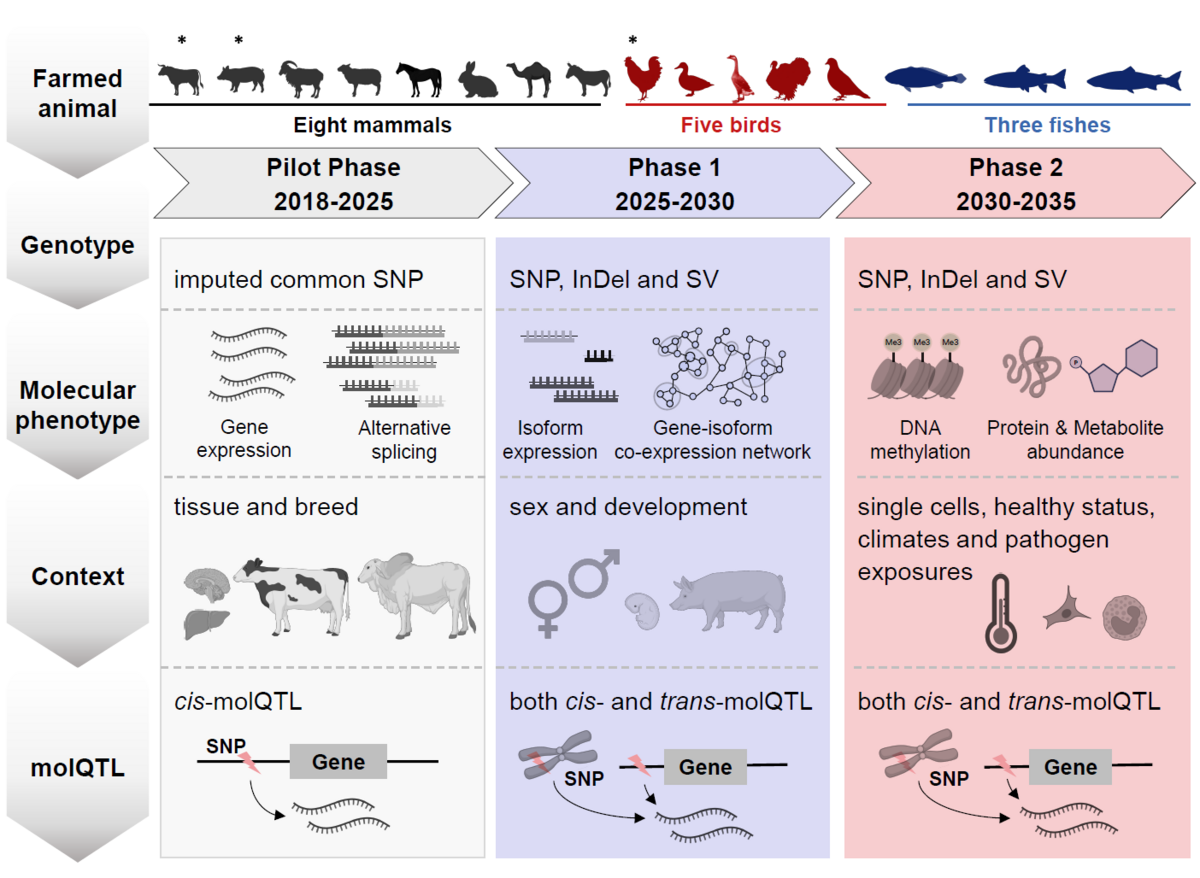
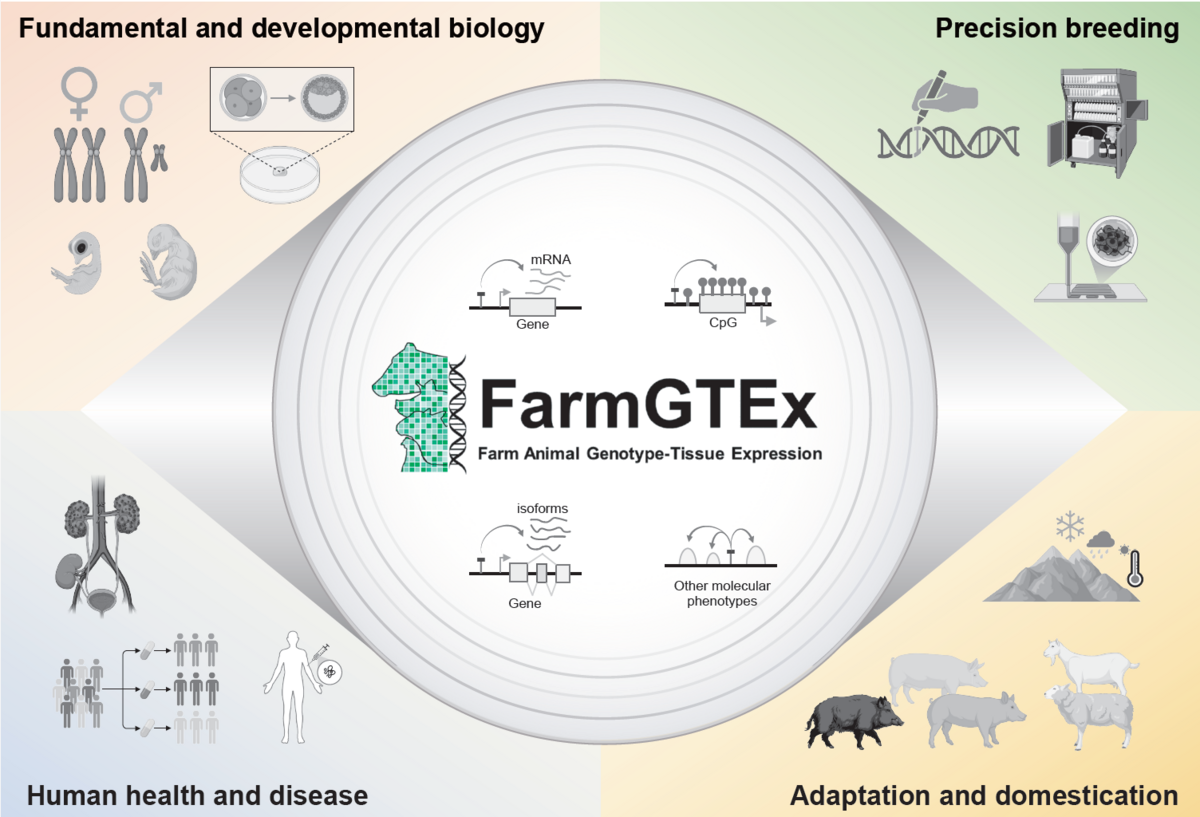
The above figures are from the overview article in Nature [March 2025, ed.], and show the extensiveness of the Farm GTEx project, both in time and scope of species.
You were granted the prestigious Sapere Aude grant from Independent Research Fund Denmark earlier this year. What is the project about?
'- In a short word, the project is trying to use state-of-the-art artificial intelligence methods, as we call it, the large language model, and to learn the DNA sequence across multiple species, and then find a way in this DNA large language model to understand how the DNA regulates gene expression in different tissues, cell types, and across different species. And then, we would like to use this knowledge and insights to understand the mechanisms underlying human diseases, and try to figure out which species, like a pig, maybe sheep or goat or chicken, is the best animal for studying a certain human disease in which tissue, cell type, and developmental stage,’ Lingzhao explains.
If I understand you right, the Sapere Aude grant is another piece to the huge FarmGTEx puzzle?
‘- Yes, this is another piece and also very important. If you look at figure 3 in the FarmGTEx perspective paper that we talked about (see the illustration above), there are four potential applications listed for FarmGTEx resources in life science. The first part is to understand the basic biology like sex and development, followed by precision breeding and understanding domestication and adaptation. Ultimately, we have a program to use this resource to understand human diseases and find the ‘perfect’ animal models for human biology and diseases. This Sapere Aude project is trying to understand the basic biology and evolution of gene regulation across species and then translate the knowledge and insights to solve human diseases. So, this is a piece of the puzzle, where we're going to link the FarmGTEx resource to human health.’
What made you choose genetics and genomics?
‘- At the start of my high school, I really loved biology and was interested in understanding how the DNA sequence influences phenotypes like diseases in humans and animals. Later during my Master and PhD, I got a background in bioinformatics and statistical genetics, and then I started to focus on computational biology. So, that's where it comes from.’ Lingzhao explains.
Who is the person behind the researcher?
‘- I was born in a small village in the middle part of China, spent my first 7 years in that beautiful place, and then moved to different cities for my primary and high schools, and then university. When I was 26, I moved to QGG for my PhD training. In my spare time, I like riding bikes, rowing, kayaking, playing video games, and reading history books. That's the kind of thing I'm interested in.’
So, you do have time to do other things than research?
‘- Yes, but especially at the weekends,’ Lingzhao says, and continues: ‘During weekdays, it's quite busy to coordinate the FarmGTEx because there are many international meetings and research projects going on. But I have to do other things after work. It’s a matter of trying to clean my mind and to refresh myself and later I can continue to work.’
How many children do you have?
‘- Only one, he is the same age as my PhD, and he was born in Sweden. I finished my PhD in May 2017, and then my boy was born in October that year. So, it's a very big year for us. My boy is actually named after Peter Sørensen and Peter Løvendahl. Because my wife's supervisor was Peter Løvendahl and my supervisor was Peter Sørensen. So, we decided to name our son Peter,’ Lingzhao says with a big smile.
What is the biggest cultural difference, you have experienced between Denmark and China?
‘- The biggest culture difference…let me think…, the biggest cultural difference I have experienced is, of course, the language, and then probably that in Denmark, people are quite open-minded and happy to exchange ideas.’ He pauses to reflect.
‘- More specifically, like in our working place at QGG, we have the open-door office and coffee break which make us inclined to communicate more. And another thing is the education system, especially for junior school. Like in my son’s case, they don't have a lot of homework after school. They learn knowledge, and at the same time they focus on how things work and are encouraged to aim high, be kind, join in and respect all. But now things are changing a lot in China,’ Lingzhao concludes.
What is a tenure track position?
The position as assistant professor/researcher can be filled as part of a tenure track course, where the employee after a maximum of 6 years moves to an appointment as associate professor/senior researcher. The transfer requires that the employee is assessed as professionally qualified to lecturer/senior researcher level.
(From Act on position structure for academic staff at universities (Retsinformation))